How to fix the Unbound module Graphics in an ocaml project
Image
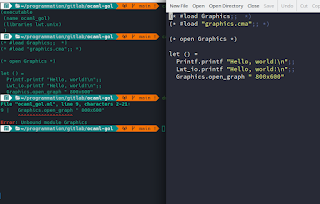
From ~/pr/gitl/ocaml-gol In a constant effort to learn new programming languages, I'm currently trying to use ocaml , a free and open-source general-purpose, multi-paradigm programming language maintained at the Inria . It's basically an extension of Caml with object-oriented features. I'm mostly interested by its functionnal and pattern matching features but the module part of the language can be a bit difficult to understand for someone with little to none ML (Meta Language) background.   The error When trying to use the graphics module to create a graphical window and go just a little further than the simplest helloworld program, here is the result : If the project uses dune : (executable (name ocaml_project) (libraries lwt.unix graphics) ) with this code : let () = Printf.printf "Hello, world!\n";; Lwt_io.printf "Hello, world!\n";; Graphics.open_graph " 800x600";; The first times I built this project running the du...

How RainbruRPG will handle game states

This design-related post will try to explain how we're implementing RainbruRPG's game states.

As stated in the last announcement, we now have to handle multiple states : main menu and local test. The game states will allow us to have multiple screens, one at a time.

UML diagrams

The class diagrams show the StateManager as a separated class from the GameEngine one. The GameEngine class publicly inherits StateManager and has access to its members/functions.

RainbruRPG's StateManager UML class diagram
The sequence diagram shows how we'll call each function :
RainbruRPG's game state sequence diagram

This is a simplified version, without any event handling or class members.

C++ implementation

The StateManager class

The StateManager is pretty simple.
class StateManager
{
public:
  StateManager(GameEngine*);
  ~StateManager();

  GameState* getCurrentState()const;
  void setCurrentState(GameState*);
 
protected:
  GameEngine* mGameEngine;
  GameState* mCurrentState;
};
I removed all obvious functions implementation, like getter, destructor etc...
StateManager::StateManager(GameEngine* ge):
  mGameEngine(ge),
  mCurrentState(NULL)
{

}

void
StateManager::setCurrentState(GameState* gs)
{
  if (mCurrentState)
    mCurrentState->exit(mGameEngine);

  // Actually changing gamestate
  mCurrentState = gs;
  gs->enter(mGameEngine);
}

The GameEngine class

Here are the changes involved in the GameEngine class :
class GameEngine: public StateManager
{
  GameEngine();
};
And its constructor implementation :
GameEngine::GameEngine(void):
  StateManager(this)
{
  MainMenu mm;
  setCurrentState(&mm);
}

The GameState class

Note that this is just an interface, containing pure virtual functions you'll need to implement in subclasses.
class GameState
{
public:

  GameState(){};
  virtual ~GameState(){};
  
  virtual void enter(GameEngine*)=0;
  virtual void exit(GameEngine*)=0;

};

Conclusion

This is not the current implementation used in RainbruRPG but the state mechanism is here. The implementation already started here.

Comments

Popular posts from this blog

How to fix the Unbound module Graphics in an ocaml project